For mechanical engineers and students who want to move into higher-demand roles
Prepare, Simulate and Validate Real FEA Projects in 5 Hours or Less
Using SolidWorks Simulation as the tool — and a proven industry validation workflow built from 12+ years of real-world FEA experience
WITHOUT spending months on random tutorials or $1000+ on standard courses
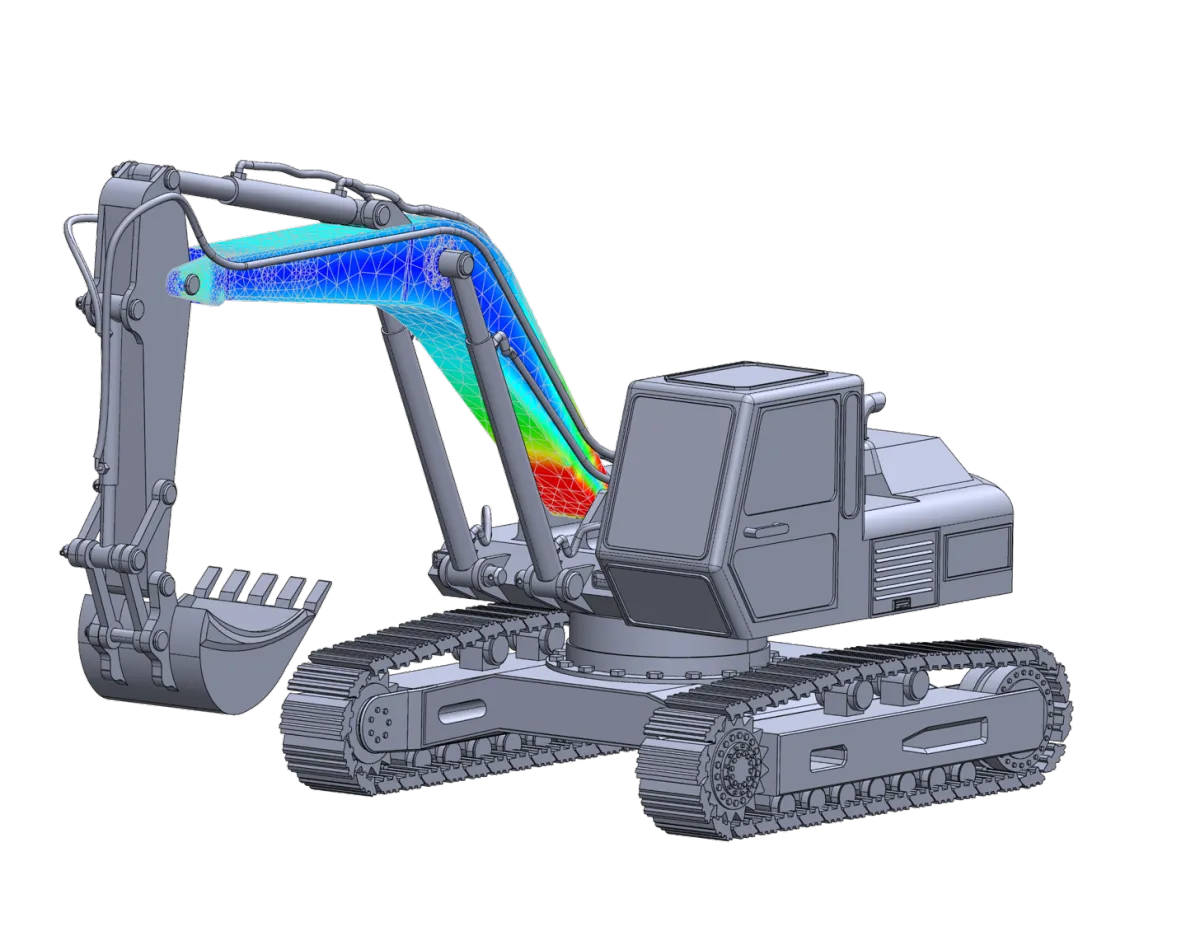
This Method guides you to validate FEA Simulations using real projects, so you stop guessing and start making engineering decisions with confidence.
No button-clicking tutorials.
No academic or oversimplified examples.
Only the reasoning used in real industry projects.
Price $199 $47
I used to avoid FEA tasks at work because I wasn’t confident. This training made it click for me. I even used the truck chassis project as part of my application for a new job—and it helped land an interview
Loved it!! The representation of the real-world scenarios as external loads was easy to understand. After a thorough search on the internet, I found that this is one of the best and easiest courses to understand!!!
This course mixes a lot of FEA concepts with really helpful examples. Each example is explained super well step by step makes this course much more wonderful. Thanks!!
Let's Face the Truth... FEA is no longer optional
Companies today don’t just want engineers who can run simulations, they want engineers who can validate results, and make confident decisions before anything is built.
THE PROBLEM?
Most engineers don't struggle with FEA because it's "too advanced"
They struggle because they were never taught how to validate results with confidence

Endless YouTube tutorials
Random tips, no validation logic, no feedback.
You learn how to click buttons — not how to trust results.
Oversimplified exercises
Clean geometries. Perfect loads. No ambiguity.
Nothing like the parts you actually design.

Theory-heavy courses
Equations, definitions, and menus.
But no guidance on real-world modeling decisions.

Overpriced master’s programs
$3,000+ for academic depth —when what you really need is practical validation judgment.
The problem isn’t you
It’s that FEA is rarely taught as a decision-making tool.
FEA Doesn’t Need to Be Hard
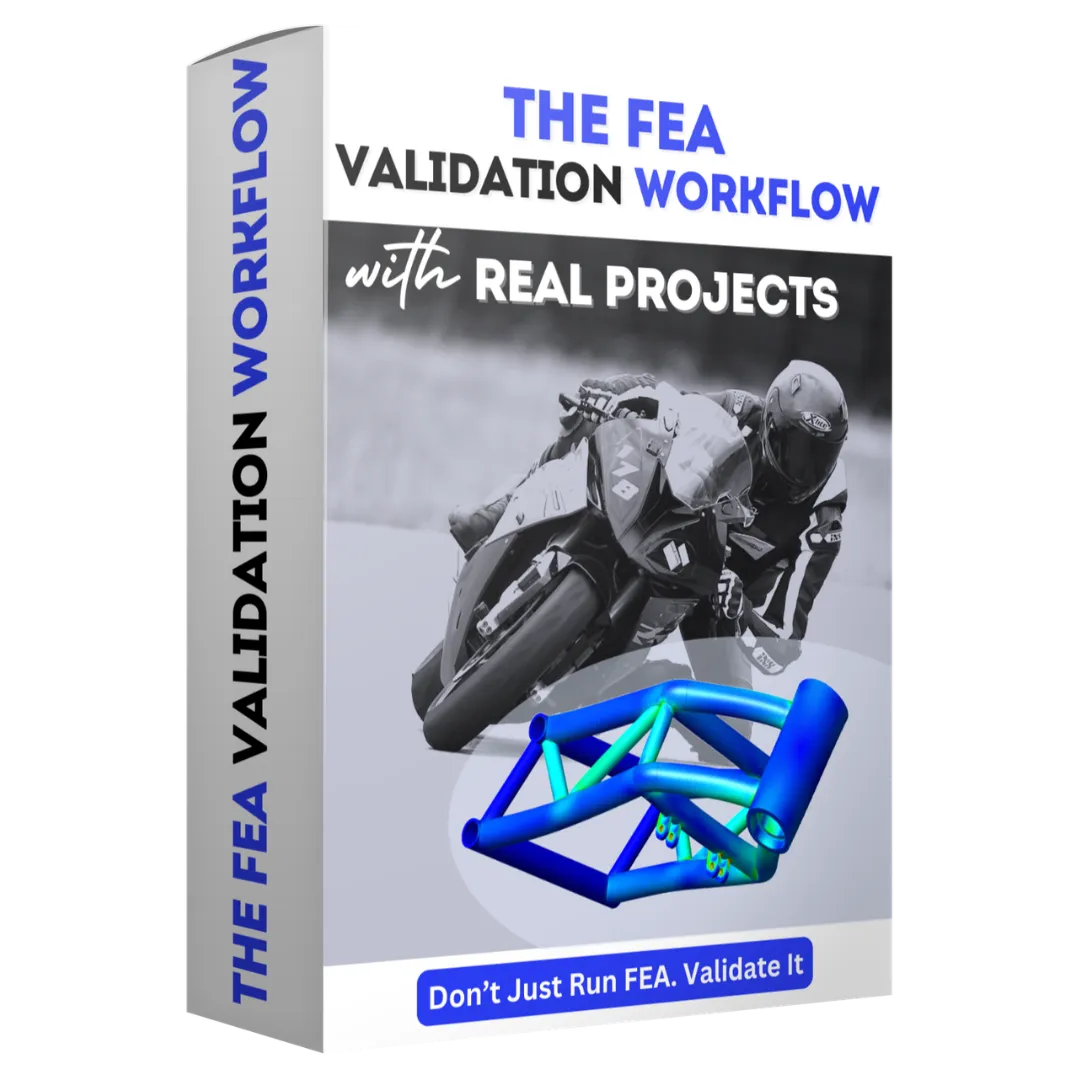
THE FEA VALIDATION WORKFLOW
A structured process used to determine when a simulation is reliable enough to support a design decision.
Instead of memorizing steps, you learn how to think:
Why modeling decisions are made
What to question at every stage
How to judge whether a result makes physical sense
You don’t just run simulations.
You learn how to trust them.
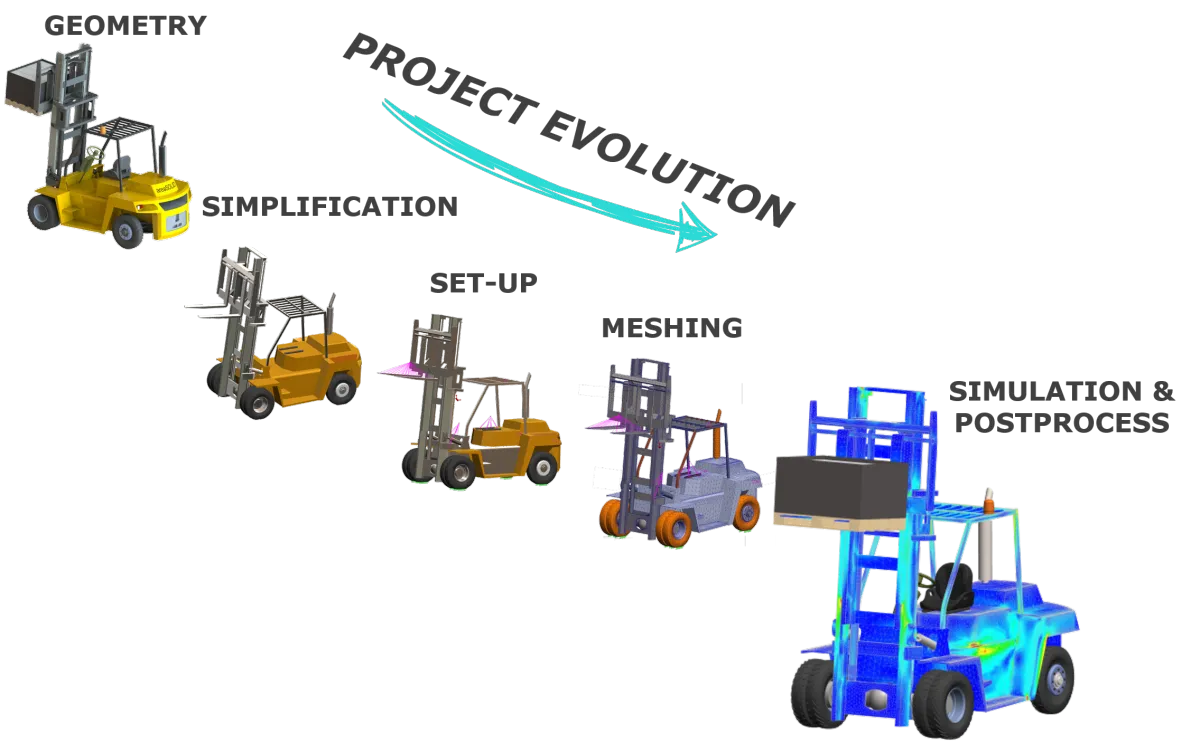
OPTIMIZE YOUR GEOMETRY for efficient, accurate FEA models, not just CAD
Build and customize your own MATERIALS LIBRARY
Apply realistic LOADS & CONSTRAINTS detecting when they are wrong.
MESH ACCURATELY and EFFICIENTLY to ensure reliable results doing all the checks to trust your FEA Results.
RUN simulations correctly and AVOID SETUP MISTAKES
VALIDATE YOUR RESULTS before using them to make engineering decisions
And... Once you go through the Complete Validation Workflow
You apply it to real projects
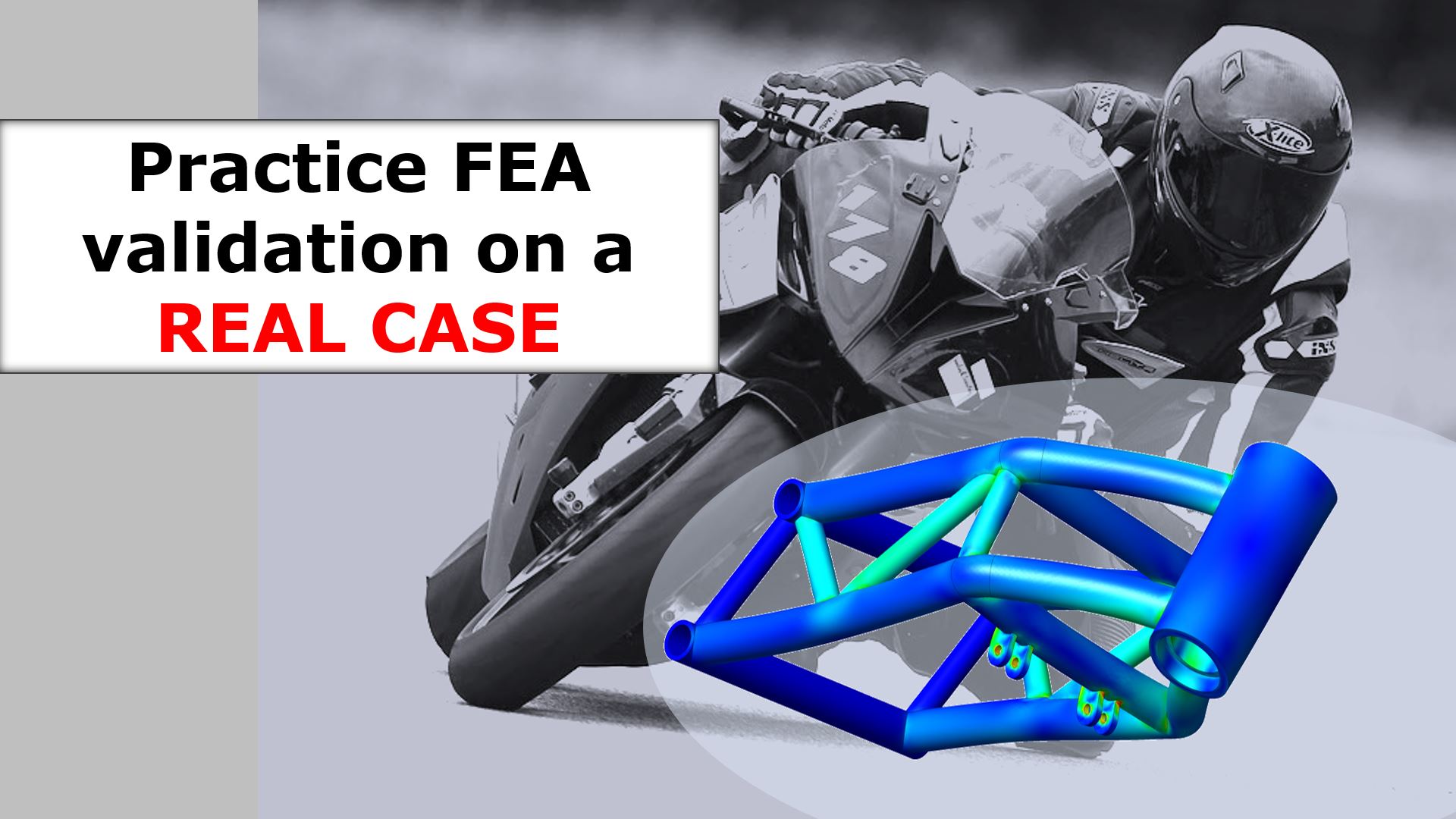
FINAL VALIDATION CASE:
Bike Chassis Under Cornering Load
Practice thinking like a CAE engineer responsible for the result
Translate real-world behavior into an FEA model
Apply loads and constraints with engineering judgment
Detailed stress analysis shows where the chassis might fail or deform.
Identify modeling mistakes before they lead to wrong conclusions
And decide when the simulation is reliable enough to be used
This is where FEA stops being software and becomes engineering judgment.
You stop guessing. You trust your results. You support real design decisions.
Price $199 $47
See what they are saying

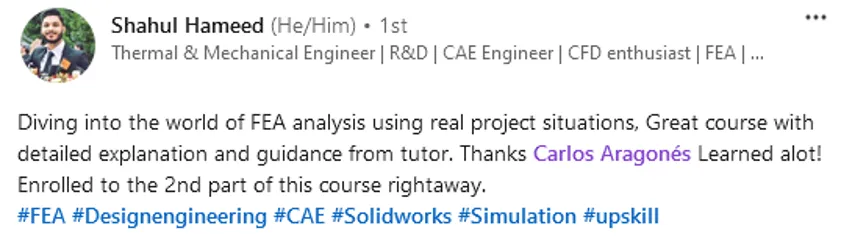
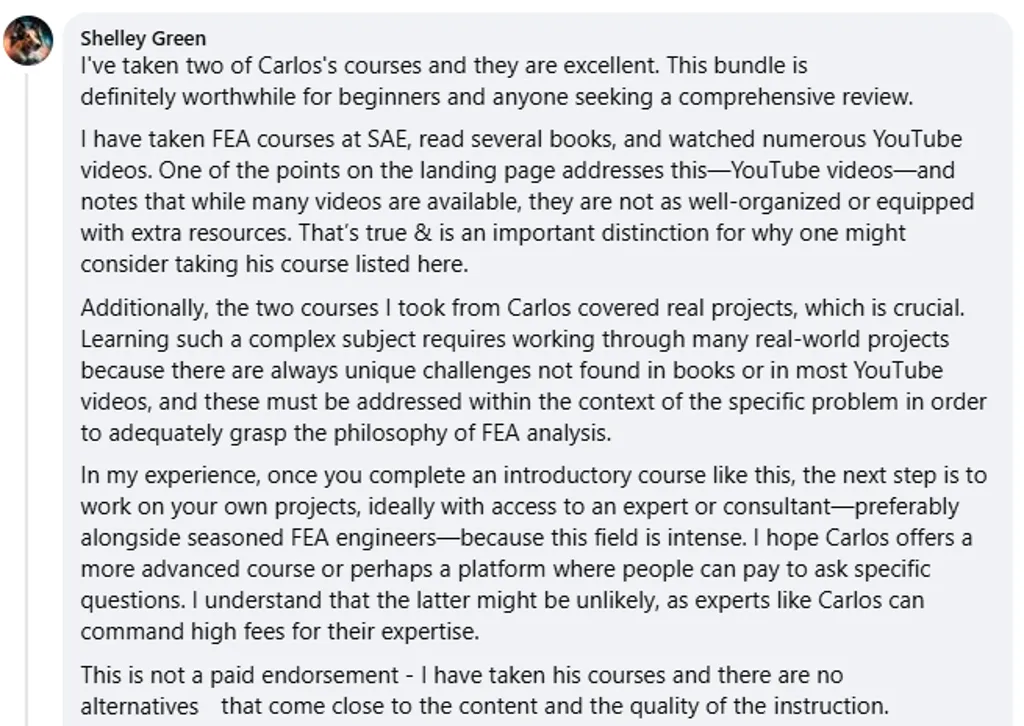
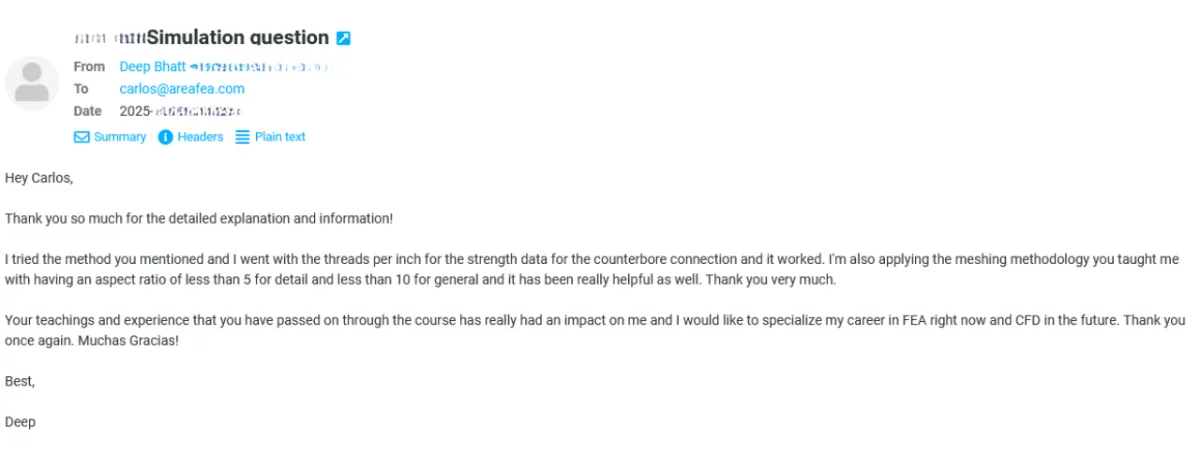
This course exceeded my expectations in every way. The instructor does an excellent job explaining the concepts, introduces both surface and linear elements in addition to 3D type elements using interesting projects. Top recommendation!
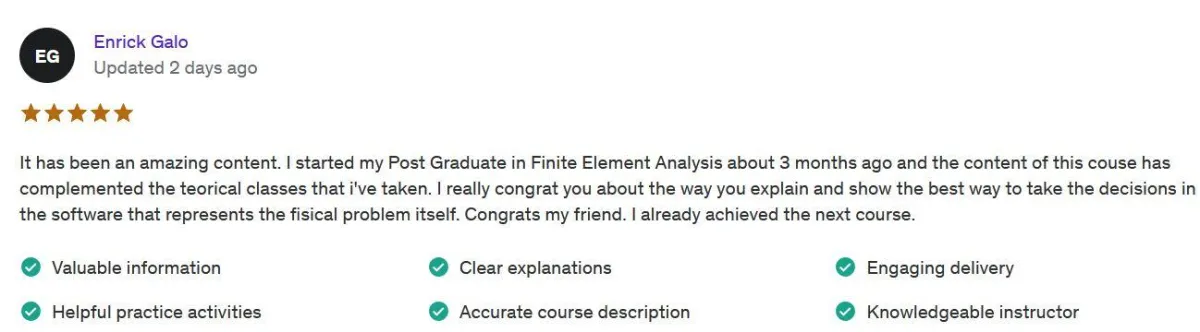
It has been an amazing content. I started my Post Graduate in Finite Element Analysis about 3 months ago and the content of this couse has complemented the teorical classes that i've taken. I really congrat you about the way you explain and show the best way to take the decisions in the software that represents the physical problem itself. Congrats my friend. I already achieved the next course.
A key benefit of this program is that it offers a practical, hands-on approach to mastering FEA in a short amount of time. Unlike traditional, theory-heavy courses, it focuses on real-world applications, teaching students how to use FEA in real engineering projects. This gives us the skills we need to immediately apply FEA in our jobs, increasing our professional value and problem-solving capabilities. Thank you so much for this content!
This is just an amazing material, I would highly recommend for someone who want to enter the world of FEA. Nice explanation by the author makes this course more wonderful. Thanks Sir
This content surpassed my expectations. It's exceptionally well-explained, both in theory and in its application through SolidWorks FEA
Excellent course — very illustrative and well-structured. It helped me finally understand how FEA works in real-world applications.
What's inside?
Foundations of FEA & the Validation Mindset
▸ WELCOME
▸ ABOUT THE COURSE
▸ INTRO TO FEM (Finite Element Method)
▸ CAE SOFTWARE IN THE MARKET
▸ SOLIDWORKS SIMULATION. Inside the CAE Software

Preparing for a Simulation You Can Trust
▸ Preparing the Geometry. PRE-PROCESS
▸ Preparing the Geometry. SPLIT LINE
▸ Preparing the Geometry. REFERENCE GEOMETRY. Coordinate Systems Definition
▸ MATERIALS Definition. Create your Own Library

Defining Reality: Loads, Constraints & Assumptions
▸ Boundary Conditions. DEFINITION
▸ Boundary Conditions. CONSTRAINTS
▸ Boundary Conditions. LOAD CASES in Vehicle Enviroment
▸ Boundary Conditions. LOAD CASES in FEA

Meshing, Solvers & Knowing When to Stop
▸ Meshing. STANDARD
▸ Meshing. CURVATURE
▸ Meshing. CONTROLS
▸ SOLVER. How to choose it?
▸ SOLVER. Define and Run the Simulation

Interpreting Results & Making the Call
▸ Results Review: Post-Process. PART I
▸ Results Review: Post-Process. PART II
▸ Results Review: Post-Process. PART III
▸ Duplicate and Compare different Simulations
▸ The Power of the Load Case Manager

PROJECT — Motorbike Chassis: Full FEA Validation Case
▸ BIKE CHASSIS. Project Presentation
▸ BIKE CHASSIS. Geometry Preparation. Part I
▸ BIKE CHASSIS. Geometry Preparation. Part II
▸ BIKE CHASSIS. Element Definition & Materials
▸ BIKE CHASSIS. Constraints and Contacts Intro
▸ BIKE CHASSIS. External Loads. Part IBIKE CHASSIS. External Loads. Part II
▸ BIKE CHASSIS. Meshing
▸ BIKE CHASSIS. Results Review. Post-Process
▸ BIKE CHASSIS. Complete Frequency Analysis

CONCLUSIONS & YOUR ROADMAP
▸ CONCLUSIONS
▸ YOUR ROADMAP DETAILS
▸ YOUR TITLE
Price $199 $47
BONUSES
🎁 Included with Your Enrollment

BONUS #1 - Simulation Validation Feedback
Get feedback on your simulation decisions — the same kind of validation engineers seek before signing off real projects.
Use the Academy forum to:
sanity-check modeling assumptions
confirm boundary conditions and loads
validate whether results are trustworthy
This isn’t hand-holding.
It’s engineering validation, so you’re never guessing alone.

BONUS #2 - Certificate of Completion
Receive a certificate confirming completion of the Simulation-Confident Engineer program.
Useful for:
LinkedIn and resumes
students and early-career engineers
documenting professional development
The real value isn’t the certificate, it’s the ability to defend your simulation decisions with confidence
Who is this program FOR?
You’re a designer or engineer — or a final-year / MSc student — who wants to approach FEA with the same mindset used in real engineering projects.
You want to validate real-world FEA simulations and trust that your results are reliable.
You’re tired of scattered tutorials and want a clear validation process that actually works
You want to learn by doing, through real engineering projects — not academic exercises
You want to stop second-guessing your simulations and make defensible engineering decisions
Who is this program NOT for?
You want quick answers without understanding why
You expect results without practicing and applying the method
You prefer theory-only learning with no real project responsibility
You’re looking for a shortcut or a “watch and forget” course
Regular Price $199 $47
30 Day Money-Back Guarantee
If within the first 30 days you feel this program does not improve the way you approach, validate, and trust FEA simulations, email us and you’ll receive a full refund.
No pressure. No questions asked.
We’re confident in the method — and we want you to evaluate it risk-free.

FREQUENTLY ASKED QUESTIONS
Is this training really effective?
Yes — because it focuses on how engineers validate simulations, not on memorizing software steps.
You’ll learn a structured decision-making process used in real industry projects to determine when a simulation can be trusted and when it cannot.
That’s why the method applies beyond a single project or analysis type
Do I need to have FEA Knowledge before starting?
Basic familiarity with SolidWorks and mechanical engineering concepts is helpful, but you do not need advanced FEA expertise.
The program is designed to take you from “I can run simulations” to “I can validate and defend my results.”
Students in their final year and working engineers both fit well if they’re willing to apply the method.
What software is used?
The program uses SolidWorks Simulation as the primary tool.
However, the validation logic and decision-making framework you learn are software-agnostic and transferable to tools like ANSYS or Abaqus.
This is about how to think, not just which buttons to click.
How long do I have access to the program & when does it start?
You get lifetime access to the program and all future updates.
Access starts immediately after enrollment, so you can begin whenever it fits your schedule.
What skill level is this program for?
This program is ideal for:
- Mechanical / design engineers who already use CAD and want reliable FEA results.
- Final-year or MSc students preparing for industry roles.
- Engineers who want to stop guessing and start validating simulations.
It is not intended for absolute beginners or theory-only learners.
Can't I learn all of this on Youtube?
You can find individual tips on YouTube — but not a complete validation process.
This program gives you:
- A structured method.
- Real projects.
- Decision-making context.
That’s what saves months of trial and error and prevents false confidence from incomplete information.
Should I invest in this before more advanced FEA courses?
Yes — because this program builds the foundation that advanced FEA relies on.
Before moving into nonlinear, fatigue, or dynamic analyses, you need to know how to:
- Model reality correctly
- Validate assumptions
- Interpret results responsibly
This program gives you that foundation, making any future specialization far more effective.
Price $199 $47
MEET YOUR INSTRUCTOR

Hi, I’m Carlos.
I’m a Mechanical Engineer with over 12 years of experience in Finite Element Analysis (FEA), working across industries such as automotive, energy, and advanced manufacturing.
Throughout my career, I’ve worked with high-end CAE tools like ANSYS, ABAQUS, NASTRAN and LS-DYNA, validating real components where simulation results directly impacted design decisions, cost, and safety.
What I do in this program is simple — but rare:
I translate the way professional CAE engineers think into a practical validation method that design engineers can actually use.
I don’t teach FEA as theory or software features.
I teach how to judge simulations, spot invalid assumptions, and decide when results are reliable enough to sign off.
Simulation-Confident Engineer is built from real industry experience — the same reasoning used before approving simulations in professional environments — adapted for engineers working with SolidWorks Simulation.
If you want to stop guessing and start trusting your FEA results, you’re in the right place.